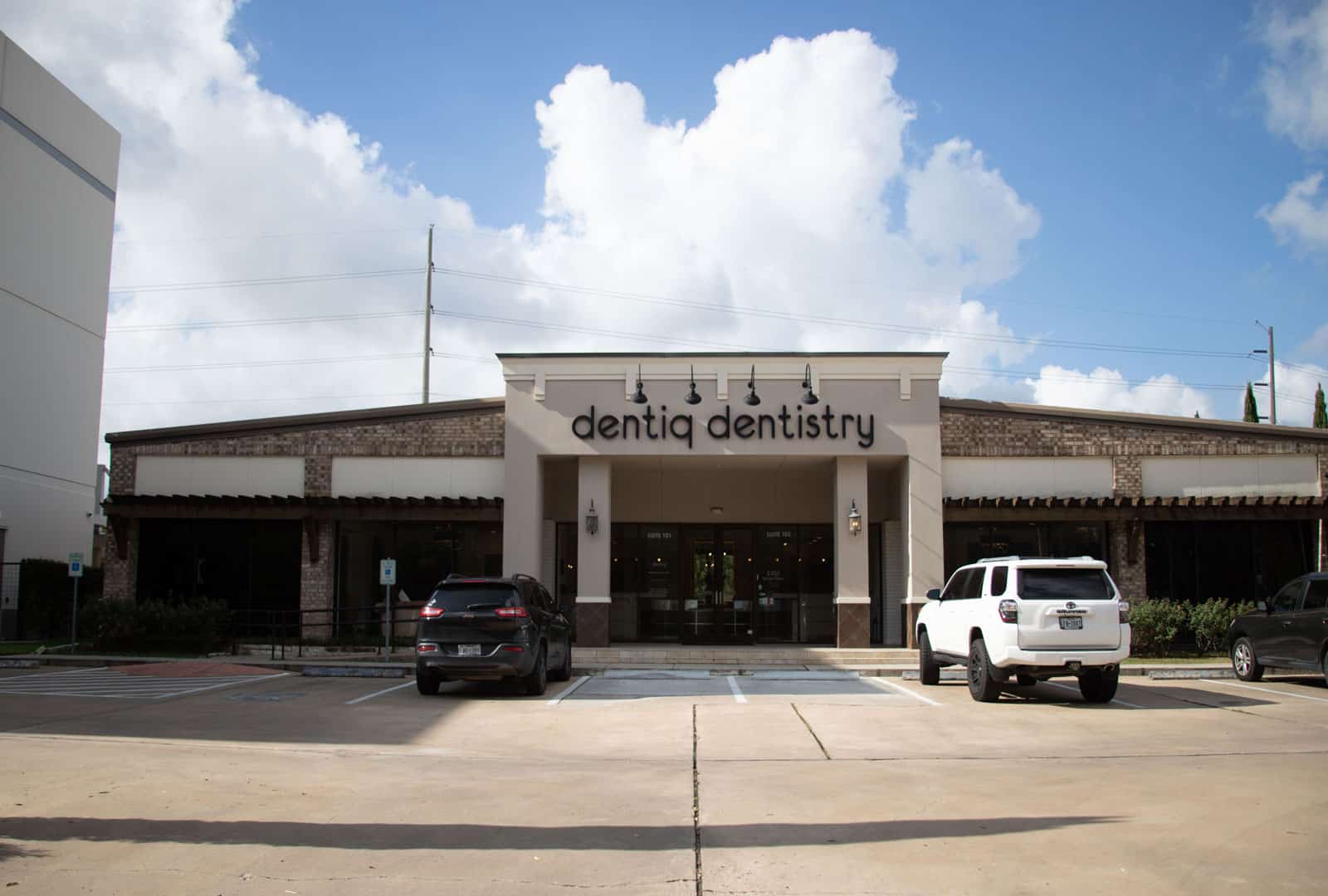
June 8, 2026 · Dentiq Dentistry
Is Invisalign or Clear Aligners Right for You? A Houston Patient's Guide
Clear aligners — whether Invisalign or another brand — are a reasonable option for most adults and teens with mild to moderate orthodontic issues. If you have crowding, spacing, or minor bite problems and you’re willing to wear trays for 20–22 hours a day, there’s a good chance you’re a candidate. If your case involves significant bite correction, rotated teeth, or complex jaw alignment, traditional braces or a combination approach may work better. The sections below walk through how to think about that decision as a Houston patient.
What Clear Aligners Actually Do (and Don’t Do)
Clear aligners work by applying controlled, incremental pressure to move teeth into a target position over a series of custom-fitted plastic trays. Each tray is worn for one to two weeks before you progress to the next in the series. Invisalign is the most widely recognized brand name, but several others — including Spark, ClearCorrect, and in-office systems — follow the same basic principle.
What they do well:
- Correct mild to moderate crowding and spacing
- Close small gaps between teeth
- Address overbite and underbite in straightforward cases
- Improve aesthetic alignment without visible metal hardware
What they’re less suited for:
- Significant vertical tooth movement (extruding or intruding teeth more than a few millimeters)
- Severe skeletal bite problems that may require jaw surgery
- Rotations of round teeth like canines, which can be mechanically difficult
- Cases where a patient’s compliance is likely to be inconsistent — the trays only work when they’re in
The honest reality is that “clear aligners vs. braces” isn’t always the right frame. For many patients, the real question is which system gets you to the result you want within your timeline and budget, and both have legitimate trade-offs.
Who Is a Good Candidate for Invisalign or Clear Aligners?
A good candidate is typically someone with:
Mild to moderate orthodontic needs. The American Association of Orthodontists broadly categorizes malocclusion severity. Clear aligners are most predictable for Class I cases — teeth that are generally aligned in the jaw but have crowding, spacing, or minor rotation issues.
Realistic expectations about wearing the trays. This is the part many patients underestimate. Invisalign trays need to be in your mouth for 20–22 hours every day. You take them out to eat and brush, and that’s essentially it. Patients who think they can wear the trays “most of the time” will stretch their treatment timeline significantly or not reach their final result.
Healthy gums and teeth. Active gum disease or untreated cavities should be addressed before starting any orthodontic treatment. This isn’t a barrier for most patients — it just means your general dental health needs to be in order first.
Adult or teen patients. Clear aligners are approved for teens (Invisalign has a Teen-specific product with compliance indicators built into the trays), and they’re widely used by adults who want a low-profile option. Young children whose permanent teeth haven’t fully come in are generally not candidates yet.
A preference for removability. Athletes, musicians who play wind instruments, and people who frequently speak publicly often prefer clear aligners specifically because they can be removed for specific activities.
How the Process Works, Start to Finish
Understanding what you’re signing up for makes the decision easier. Here’s a typical clear aligner treatment sequence:
Initial consultation and records. Your provider takes digital scans or impressions of your teeth, along with photographs and sometimes X-rays. These are used to build a 3D model of your current bite.
Treatment planning and ClinCheck (or equivalent). Invisalign uses software called ClinCheck that generates a virtual simulation of how your teeth will move through the series. You can see an approximation of your projected final result before any trays are made. Other aligner systems have similar planning tools.
Tray fabrication. Once the treatment plan is approved, trays are manufactured — typically a few weeks later. Depending on your case, you may receive the full series at once or in batches.
Attachments. Many clear aligner cases require small tooth-colored composite bumps (called attachments or engagers) bonded to specific teeth. These give the plastic trays more leverage for certain movements. Don’t be surprised if your provider mentions needing them — they’re common and nearly invisible.
Progress appointments. Unlike braces, which typically require monthly adjustments, clear aligner patients usually check in every 6–10 weeks. These visits confirm teeth are tracking as planned and allow for any mid-course corrections.
Retainers. After active treatment ends, retainers are non-negotiable. Teeth will shift without them. Most providers prescribe nightly retainer wear indefinitely — not just for a year or two.
Total treatment time for mild cases can be as short as six months. Complex cases can run 18–24 months or more. The average is somewhere around 12–18 months, though individual variation is significant.
Invisalign vs. Other Clear Aligner Brands: What’s Actually Different?
Invisalign has the longest track record — the company has been refining its system since the late 1990s and has treated tens of millions of cases worldwide. That history means a large body of clinical data and a broad network of trained providers.
Other brands like Spark (made by Ormco, an established orthodontic company) and ClearCorrect (owned by Straumann) are legitimate competitors with their own clinical research and provider networks. Some dentists and orthodontists who work with multiple systems prefer them for specific case types or because of differences in material clarity and edge trimming.
What matters more than brand, in most cases: the experience of the provider planning your treatment. Clear aligner treatment is not purely automated — your provider makes judgment calls about staging movements, where to place attachments, and when mid-course refinements are needed. A skilled clinician using any reputable system will generally outperform a less experienced one using a more recognized brand.
In Houston specifically, patients have access to both general dentists certified to provide Invisalign and orthodontists who work with multiple systems. For complex cases, an orthodontist’s additional training in biomechanics is worth considering.
What to Expect at Dentiq Dentistry
At Dentiq Dentistry in Houston, clear aligner consultations start with a full clinical assessment — not just photos and scans, but a conversation about what’s bothering you aesthetically and functionally. Some patients come in focused on one crooked tooth; others have a broader bite issue they want addressed. The treatment plan needs to reflect your actual goals, not a template outcome.
If clear aligners are a good fit for your case, the practice will walk through the digital treatment simulation with you so you can see the projected tooth movement before committing. If there are reasons why braces or a different approach might serve you better, that gets explained directly rather than steered around.
Cost and financing options are discussed during the consultation. Clear aligner treatment at a general dental practice is typically in the range of $3,000–$6,000 depending on case complexity, and many dental insurance plans that include orthodontic benefits will apply to clear aligners the same way they apply to braces. Flexible payment plans are commonly available for the remainder.
Frequently Asked Questions
Are clear aligners as effective as braces? For mild to moderate cases, clinical outcomes are comparable. For complex bite correction or significant tooth rotation, braces often give the provider more control. Your provider can tell you which category your case falls into after a clinical assessment — a general answer based on photos or a description isn’t reliable.
How long does Invisalign treatment take? It depends heavily on what needs to move and how far. Simple cases (minor spacing or crowding) can finish in 6–9 months. Most moderate cases run 12–18 months. Complex cases can take longer. Compliance also matters: patients who wear their trays the full 20–22 hours a day consistently tend to finish on schedule.
Does Invisalign hurt? Most patients experience mild pressure or soreness for the first day or two after switching to a new tray. This is normal and typically fades quickly. It’s different from the tightening soreness associated with wire adjustments in braces, though both are temporary.
Can I eat whatever I want with clear aligners? Yes — unlike braces, there are no food restrictions because you remove the trays before eating. The trade-off is that you need to brush your teeth before putting trays back in, and you can’t snack casually without taking them out. Patients who drink coffee or wine should rinse before reinserting trays to avoid staining.
What happens if I don’t wear a retainer after treatment? Teeth will shift. This isn’t a scare tactic — it’s a predictable biological response. Bone remodels around moved teeth over time, but the pressure from surrounding teeth and soft tissue continues. Most orthodontic relapse happens in the first year after treatment. Consistent retainer use, especially at night, is the only reliable way to maintain results.
Ready to find out whether clear aligners are right for your case? Schedule a consultation or call Dentiq Dentistry at (713) 526-2904.