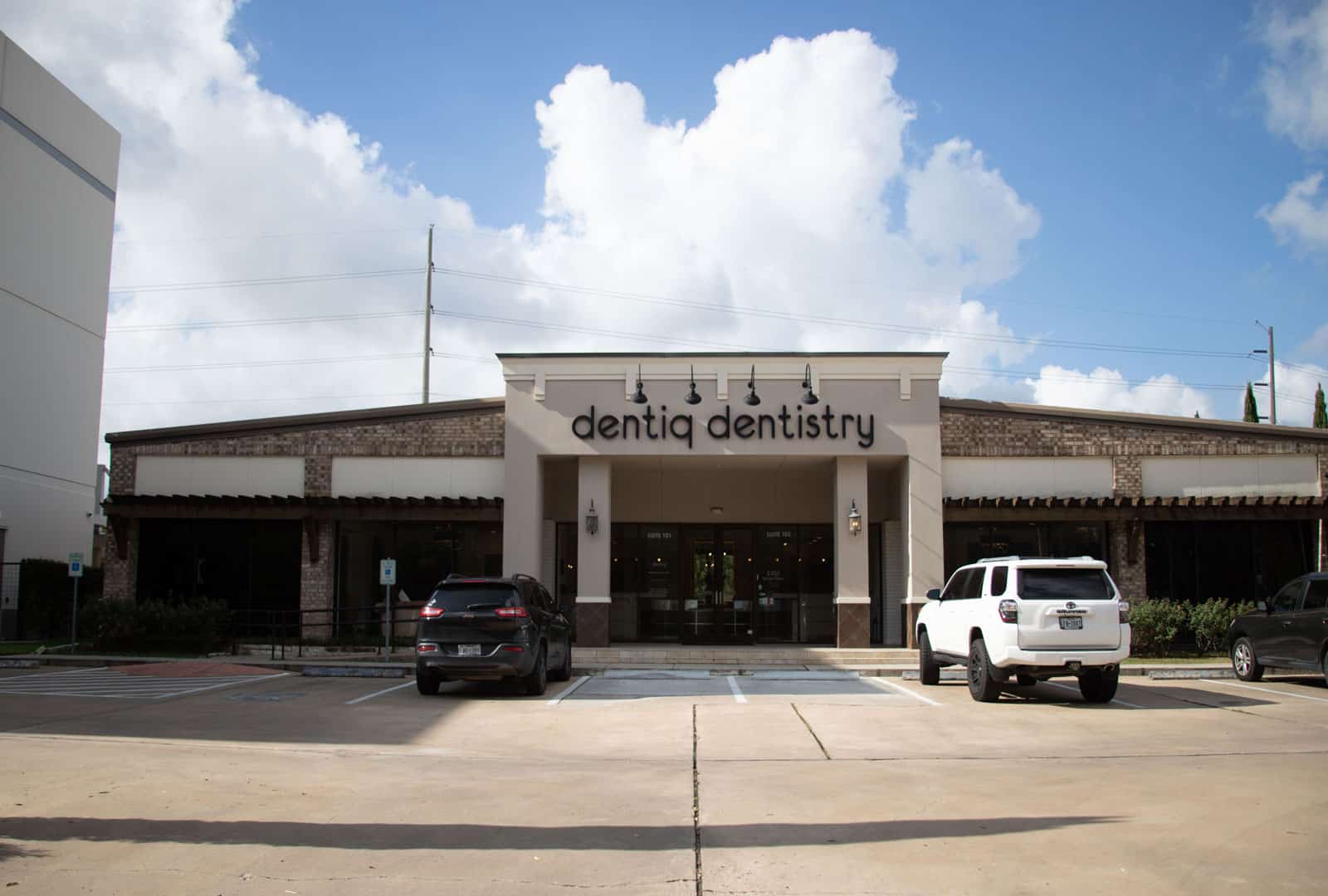
June 8, 2026 · Dentiq Dentistry
All-on-4 vs. Implant-Supported Dentures: Which Is Right for Houston Patients?
If you’re missing most or all of your teeth and researching full-arch replacement, you’ve probably landed on two options that keep coming up: All-on-4 and implant-supported dentures. Both use dental implants as anchors, both replace an entire arch of teeth, and both dramatically outperform traditional removable dentures — but they’re not the same procedure, and the right choice depends on your bone structure, budget, lifestyle, and how you define “permanent.” The short answer: All-on-4 is a fixed, non-removable arch supported by exactly four implants, while implant-supported dentures is a broader category that includes both fixed and removable prostheses supported by anywhere from two to six or more implants. Read on for a plain-language breakdown of what each actually involves.
What All-on-4 Actually Means
All-on-4 is a specific implant technique, not just a brand name. Four implants are placed in each arch — two toward the front of the jaw in a vertical position, and two in the back placed at an angle (typically 30–45 degrees). That angled placement is the engineering insight at the heart of the technique: it allows the rear implants to engage more dense bone toward the front of the jaw, which means patients who have experienced significant bone loss in the back of the jaw — a common consequence of years without teeth — can often qualify without bone grafting.
On the day of surgery (or shortly after), a full-arch prosthesis is bolted to those four implants. You leave the office with teeth. The prosthesis is fixed: it doesn’t come out at night, it doesn’t move when you eat, and it doesn’t rest on your gums. Over the following months, the implants fuse to the jawbone through a process called osseointegration. At around the 12-month mark, many patients receive a final prosthesis made from more durable materials like zirconia or porcelain.
Because the prosthesis is screw-retained rather than adhesive or suction-based, only a dental professional removes it — for cleaning, inspection, or repairs. This is often the feature patients find most compelling: it functions and feels much closer to natural teeth than any removable option.
What “Implant-Supported Dentures” Actually Covers
“Implant-supported dentures” is an umbrella term, which is part of why patients find the comparison confusing. Under this label you’ll find:
- Snap-on (overdentures): A conventional denture modified to snap onto two to four implants using locator attachments or ball attachments. The denture still comes out for cleaning. The implants prevent slippage and reduce gum pressure — a significant improvement over a traditional denture — but the prosthesis is still removable.
- Bar-retained overdentures: A custom-fit metal bar connects multiple implants, and the denture clips onto the bar. More stable than basic snap-ons, still removable.
- Fixed implant-supported bridges: Four to six or more implants support a non-removable bridge. This overlaps significantly with All-on-4 in function, though more implants can mean better load distribution and, in some cases, a more natural-feeling result.
The number of implants, the type of attachment, and whether the prosthesis is removable or fixed all vary significantly depending on which specific implant-supported denture approach your provider recommends.
Side-by-Side: Key Differences That Matter to Patients
Here’s where the practical comparison lives:
Removability. All-on-4 is fixed — period. Implant-supported overdentures come out at night or for cleaning; fixed implant-supported bridges do not. If you want to never think about removing your teeth again, only a fixed option delivers that.
Bone requirements. All-on-4 was specifically designed to work with reduced bone volume. The angled posterior implants typically reach denser bone further forward in the arch. Many overdenture designs also require limited bone, but the placement strategy differs. If bone grafting has been recommended to you elsewhere, it’s worth asking specifically whether an angled-implant approach could eliminate that step — grafting adds cost, recovery time, and complexity.
Number of implants. All-on-4 uses exactly four per arch by definition. Overdentures may use as few as two (lower arch minimum is often cited as two, though more is generally more stable). Fixed full-arch bridges often use four to six. More implants generally means better force distribution — relevant if you want to eat a wide variety of foods long-term.
Prosthesis material and longevity. The temporary prosthesis placed on the day of surgery is typically made from acrylic. Final restorations — delivered after osseointegration — are often zirconia or layered porcelain-on-zirconia. Acrylic wears faster and is less resistant to staining. Zirconia is harder and more resistant but requires careful bite evaluation. Overdentures often remain in acrylic longer because they’re easier to reline or replace.
Cost. Costs vary significantly by provider, material, and number of implants. In Houston, full-arch implant cases generally range from roughly $15,000 to $30,000 or more per arch, depending on complexity. Fixed solutions using more implants typically cost more than removable overdentures. These are substantial investments either way, and neither is typically covered by standard dental insurance (though some plans cover a portion of the implant-related surgical costs — check your specific policy).
Maintenance. Fixed arches require specialized cleaning — a water flosser and specific interdental brushes to clean under the bridge — and periodic professional removal for deep cleaning. Removable overdentures require daily removal and cleaning plus maintenance of the attachment hardware, which wears over time and needs periodic replacement.
Who Tends to Be a Better Candidate for Each
All-on-4 tends to suit patients who: have significant bone loss that would otherwise require grafting, want a fixed result on a single surgical timeline, and are prepared for the maintenance that a fixed prosthesis requires. It works for both upper and lower arches, though the upper arch sometimes needs more implants due to lower bone density in the posterior maxilla.
Removable implant-supported overdentures tend to suit patients who: want a less invasive or lower-cost entry into implant dentistry, are more comfortable with a removable appliance, or have anatomical or systemic factors that make multiple implant placements more complex.
Fixed multi-implant bridges (sometimes called “All-on-6” informally, though this isn’t a trademarked term) tend to suit patients who want maximum stability, have adequate bone volume for more implant sites, and prefer the most natural long-term chewing function.
None of this replaces a clinical evaluation. Bone density, gum health, bite forces, and systemic health factors (including conditions like diabetes or a history of bisphosphonate use) all affect implant candidacy and which approach makes sense.
What to Expect at Dentiq Dentistry
At Dentiq Dentistry in Houston, the process for evaluating a full-arch implant case starts with a thorough exam that includes 3D cone beam CT imaging. This is the imaging that actually shows bone volume and density in three dimensions — the data a provider needs to determine whether All-on-4 placement angles are viable, how many implants make sense, and whether any grafting or extractions need to happen first.
If you still have failing teeth that need to be removed, extraction timing and implant placement timing are planned together. In some cases, implants can be placed the same day as extractions; in others, a healing period is appropriate first.
You’ll also have a conversation about the prosthesis itself — material, aesthetics (tooth shape, shade), and the realistic timeline from initial placement to final restoration. Most full-arch cases involve a temporary prosthesis worn during the osseointegration period, with the final prosthesis delivered several months later.
To schedule a consultation, visit our scheduling page or call (713) 526-2904.
Frequently Asked Questions
Is All-on-4 the same as implant-supported dentures? Not exactly. All-on-4 is a specific fixed full-arch technique using four angled implants. Implant-supported dentures is a broader category that includes both removable overdentures and fixed bridges. All-on-4 qualifies as a type of implant-supported restoration, but not all implant-supported dentures are All-on-4.
Can I get All-on-4 if I’ve been told I need a bone graft? Possibly. The angled posterior implants used in All-on-4 are specifically designed to engage bone in areas where ridge height is sufficient, even when the back of the jaw has resorbed. A 3D CT scan is the only way to determine whether your bone anatomy makes grafting avoidable.
How long does an All-on-4 procedure take? The surgical placement typically takes two to four hours per arch under local anesthesia (often with sedation). A temporary prosthesis is usually attached the same day. The full process — from surgery to final restoration — generally spans nine to twelve months.
Will my implant-supported teeth look natural? Final restorations in zirconia or porcelain can look highly natural and are custom-shaded to match patient preferences. The temporary acrylic prosthesis worn during healing is functional but typically less refined aesthetically.
What happens if an implant fails? Implant failure is uncommon but does occur — most studies cite failure rates in the 2–5% range per implant over ten years, with higher rates in heavy smokers or patients with poorly controlled diabetes. In an All-on-4 case, one failed implant doesn’t necessarily mean the entire arch fails, but it typically requires replacement before the final prosthesis can be placed. This is one reason some providers prefer using more than four implants when bone allows.